

The challenge: paying for accounts nobody uses
A UK hosting provider came to us with a problem every host with resellers shares. A reseller signs up a customer, the customer moves their site elsewhere a year later, and the account just sits there — nobody tells the reseller, so nobody deletes it. Since cPanel moved to per-account pricing, every one of those dead accounts lands on the monthly cPanel bill, eats disk, and is copied in every backup run. Across their reseller servers it added up to hundreds of dollars a month for accounts nobody used.
The solution: let DNS decide what’s dead
Logins, file changes and disk use are unreliable signs of life, so we built IAM4Hosts around one question: is this account actually serving anything from this server? An account is only inactive when none of its domains — main, addon, parked or subdomain — point their website or mail here, or use a trusted nameserver such as Cloudflare. Flagged accounts then move through a four-phase lifecycle on a schedule the host sets, with removal cancelled automatically if any domain has pointed back by the final check.
Safe enough to trust with paying customers
The first question every host asks is “will it touch my customers?” So safety is built in, not bolted on: the host’s own logins go in Excluded owners and are never scanned; notices go to the reseller, never the end customer; automatic suspension and removal are separate switches that start off; and at most 20 actions run per scan, so a backlog is worked through gradually. Nothing happens without a paper trail, and any account can be kept with one click.
A closer look inside
We built the product end to end — three control-panel editions, the licensing and signed-update infrastructure, and the marketing site that turns sysadmins into customers.
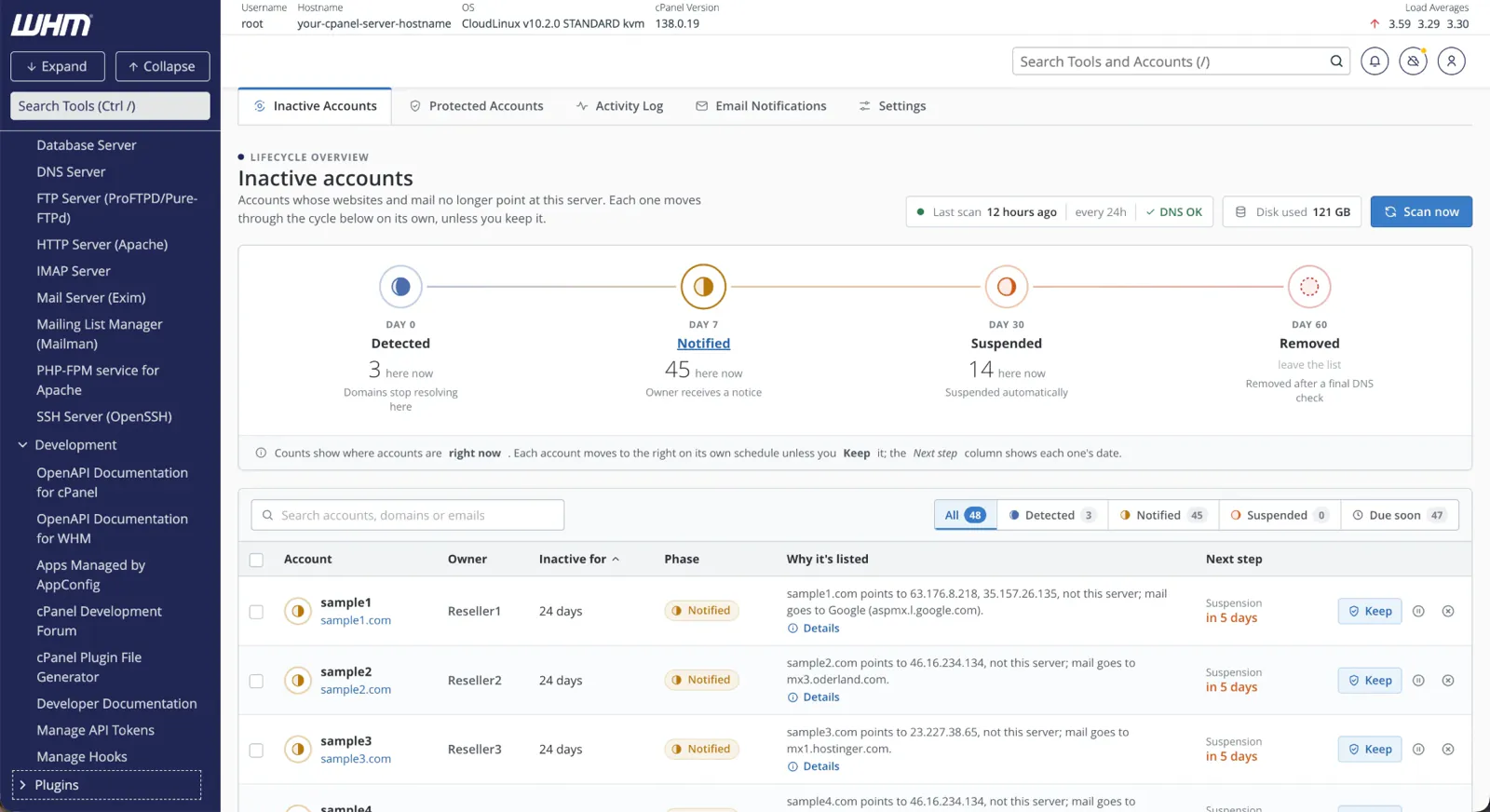
Every dead account, and exactly why
The WHM plugin shows the whole lifecycle at a glance — how many accounts sit in each phase and when each one moves on. Every row explains in plain English why it was flagged: which domains point where, and where the mail now goes.
- Search, filter by phase, and a "Due soon" view so nothing happens by surprise.
- Keep, pause or act on any account in one click — every action logged with who did it.
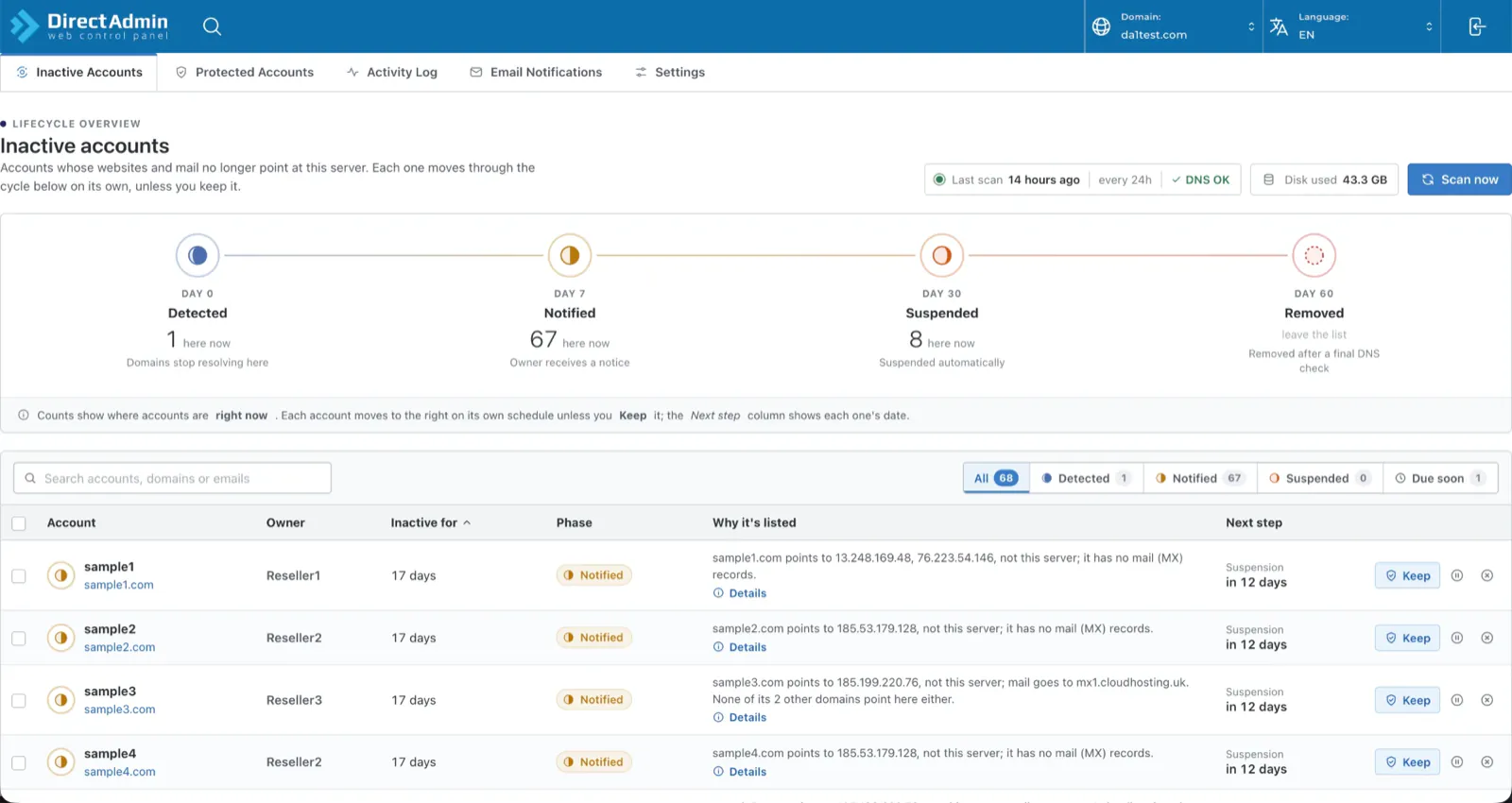
One product, three control panels
The same engine ships as a native DirectAdmin plugin and a Plesk extension for Linux and Windows, each following its panel’s own look and permission model. On Plesk it works per subscription and recognises mail hosted on a separate mail server.
- Root or admin sees the whole server; each reseller sees only their own accounts.
- Tested on WHM 138, AlmaLinux 10, CloudLinux 9 & 10 and DirectAdmin 1.712.

A site that does the maths for the buyer
We designed iam4hosts.com to sell to sysadmins: dark, precise and evidence-led. A live banner shows real totals reported by installs, and an interactive calculator lets a host work out their own monthly saving before installing anything.
- Interactive product tour and lifecycle demos, built in plain PHP with no build step.
- FAQ schema and an auto-generated llms.txt so search and AI engines can quote it accurately.

Free to try, priced to pay for itself
The Free edition installs with no signup and no licence key, finds every inactive account and shows what they cost. Premium — $49.99 per server per year — adds the full automated lifecycle, and pays for itself after removing about 11 accounts.
- Licensed by server IP and unlocks in place: no reinstall, nothing to re-enter.
- If a licence lapses, nothing is lost — the lifecycle simply pauses and resumes later.
Built to ship, not just to demo
A product other hosts install on production servers has to earn trust. Releases are signed with Ed25519 and verified by SHA-256 before anything runs; the plugin announces updates but never installs itself; and settings, templates and history survive every upgrade. Guided first-run setup means nothing is scanned until root has confirmed sensible defaults. No customer data ever leaves the server — only anonymous weekly totals, which can be switched off.
The outcome
What began as an internal cost-cutting tool is now a commercial product, live on cPanel & WHM and DirectAdmin, with Plesk heading to the Plesk Extensions Catalog.
Over $600 a month off the cPanel bill, plus less disk and smaller backups — from accounts that were doing nothing.
A clear, fair heads-up before anything happens, and a tidy list of their own dead accounts to clean up.
A new revenue line: a free edition that markets itself, and a Premium tier that pays for itself.